
Future Skills 2030. An Updated Framework for Future Skills

Future Skills 2030 – An Updated Framework for Future Skills

Whether in the context of artificial intelligence, climate change or democracy, a world in transformation will require a clear focus on future skills across all sectors of education in the coming years – from schools and higher education to vocational training and continuing education.

The Stifterverband's updated Future Skills Framework 2030 comprises 30 key future skills for the next five years. It was developed in a comprehensive process within the framework of the Alliance for Future Skills ("Allianz für Future Skills") and brings together perspectives from education, academia, business, civil society and politics.

More than 50 experts contributed to the development of Future Skills 2030. More than 1,000 stakeholders from a wide range of fields were surveyed, confirming the overarching relevance of the Future Skills Framework that was developed. 
Key Messages

  • To advance both the content and methodology of the Stifterverband’s 2021 framework, the organisation established an academic task force entitled "Future Skills 2030". The task force aimed not only to update the set of skills, but also to strengthen and expand the methodological foundations of the analysis.
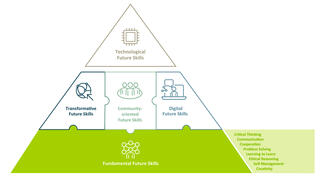
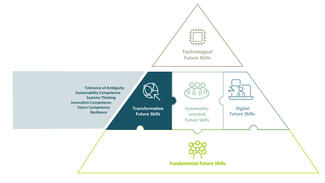
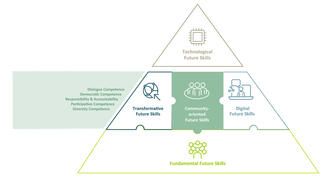
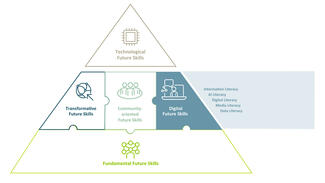
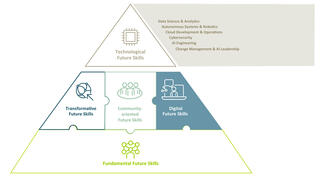
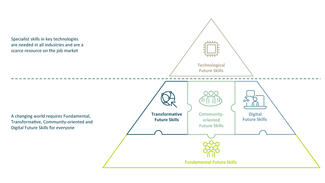
  • The Future Skills 2030 framework builds on a stable foundation of Fundamental Future Skills, unfolds across three broad competence areas – transformation, community and digitalisation – and culminates in expert-level competences related to technological excellence.
  • Fundamental Future Skills, such as critical thinking and communication, act as key cross-cutting competences and form the foundation for the other Future Skills in the framework.
  • Transformation is becoming the norm. As a result, Transformative Future Skills, such as innovation and sustainability competence, remain highly relevant.
  • The megatrend of artificial intelligence requires all learners to develop Fundamental and Digital Future Skills, including AI literacy and data literacy, alongside specialised AI skills at the expert level.
  • Active engagement with democratic culture is becoming increasingly essential, along with the corresponding Community-Oriented Future Skills such as dialogue competence and responsibility & accountability.
  • At the expert level of technological competence, cybersecurity plays an increasingly important role. Organisations need to expand expertise in this area, particularly in the context of generative AI.  
  • Depending on their sector, institutional profile and strategic priorities, institutions may assign different weights to individual Future Skills when developing curricula.
Future Skills 2030 – An Updated Framework for Future Skills

Responsible Authors

Florian Rampelt
Stifterverband

Wibke Matthes
University Kiel

Kati Hannken-Illjes
Philipps-University Marburg

Anna Sandmeir
Stifterverband


The German-language version of this framework was published in December 2025 (Rampelt et al., 2025b, Gehrs et al., 2025). The English translation was carried out in January and February 2026, drawing on established terminology and reference frameworks – including Kotsiou et al. (2022), OECD (2025), DigComp 3.0 (2025), Ehlers et al. (2022) – and with support from DeepL's AI translation tool, English native speakers, and members of the academic task force.


Zukunftsmission Bildung (Logo)
zukunftsmission_bildung_logo.jpg

With its Future Mission Education ("Zukunftsmission Bildung"), the Stifterverband aims to help shape an education system for a changing world – one that can quickly support more people with the skills they need for the future.

As part of this initiative, the Alliance for Future Skills seeks to ensure that Future Skills are firmly embedded across the educational provision of all higher education institutions.
Back to top